

Quick answer: use Echoes as character equipment, not as a collection of pieces that all deserve upgrades. First lock the correct Sonata effect and main stats into a 12-COST layout, usually 4-3-3-1-1. Then reveal substats in stages and stop when a piece no longer improves a named Resonator. Farm the open world for specific Echo copies, Tacet Fields when EXP and Tuners are the bottleneck, and Data Merge when excess unlevelled Echoes are filling the backpack.
What are Echoes in Wuthering Waves?
Wuthering Waves Echoes are the game's gear system. A Resonator equips up to five of them for main stats, substats and a Sonata set effect. The Echo placed in the first slot is the Main Echo; it also supplies the Echo Skill used in combat. The other four slots contribute stats and set pieces, but their order does not change the build.
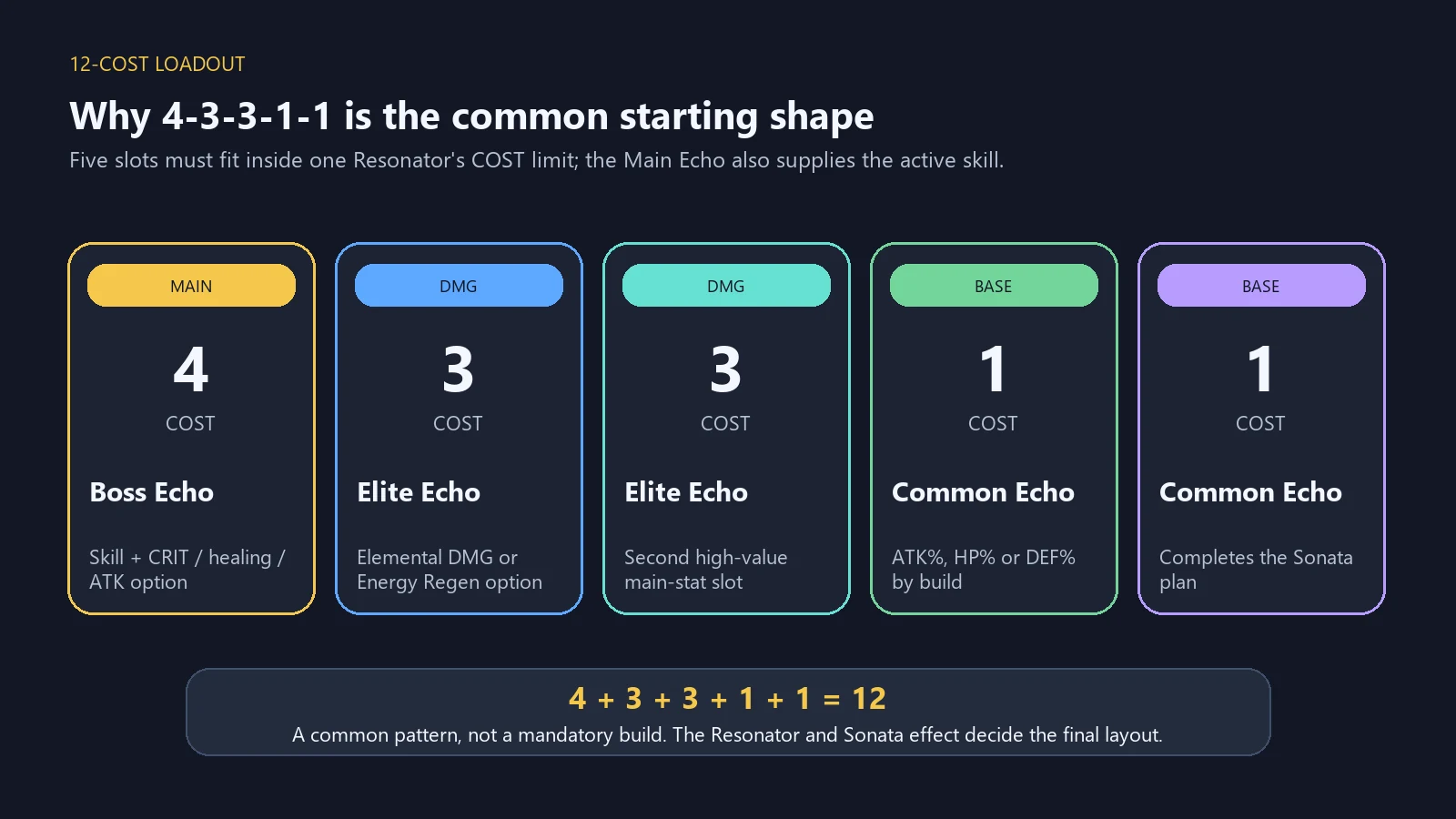
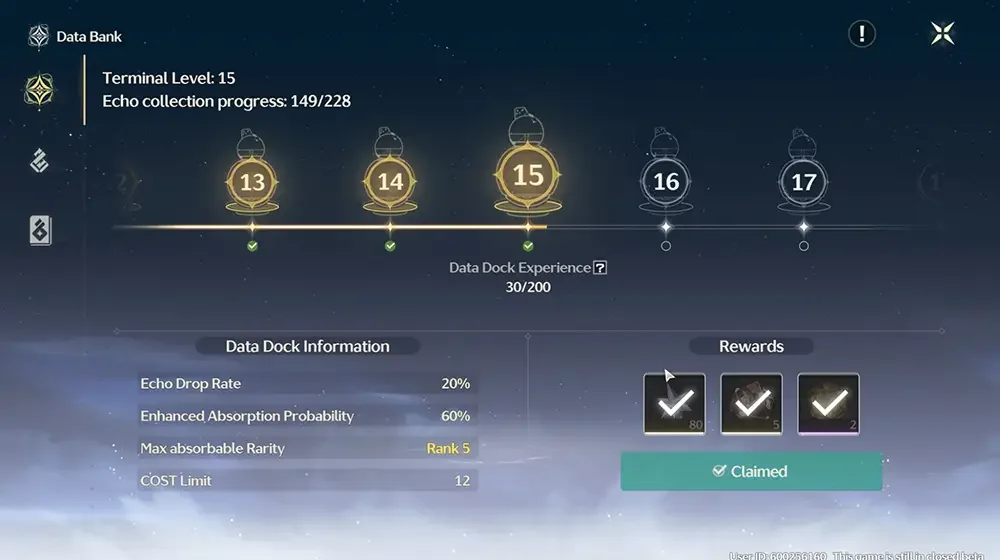
Every Echo has a COST based on its enemy class: Common Echoes cost 1, Elite Echoes cost 3, and Overlord or Calamity Echoes cost 4. Your account begins with a lower total COST limit and raises it to 12 through Data Dock progress. That 12-point cap is why 4-3-3-1-1 became the familiar five-slot layout.
Choose the layout from the owner, not from the Echo
Start with the Resonator's job. A damage dealer usually wants a Main Echo whose skill supports the rotation, a useful 4-COST main stat such as CRIT, and two 3-COST pieces that solve elemental damage or Energy Regen needs. A healer, shield unit or stat-scaling support may value Healing Bonus, HP, DEF or Energy Regen instead. Copying a damage layout onto every character wastes good support pieces and can make rotations slower.
Usually the Main Echo slot. Damage builds often compare CRIT Rate and CRIT DMG; sustain builds may use Healing Bonus, HP, DEF or ATK according to scaling.
The flexible damage and rotation slots. Compare matching elemental damage, Energy Regen and scaling stats instead of assuming the same pair works for every kit.
Efficient base-stat slots. Choose ATK%, HP% or DEF% from the character's scaling and use them to complete the intended Sonata effect.
How Echo Sets and Sonata Effects Work
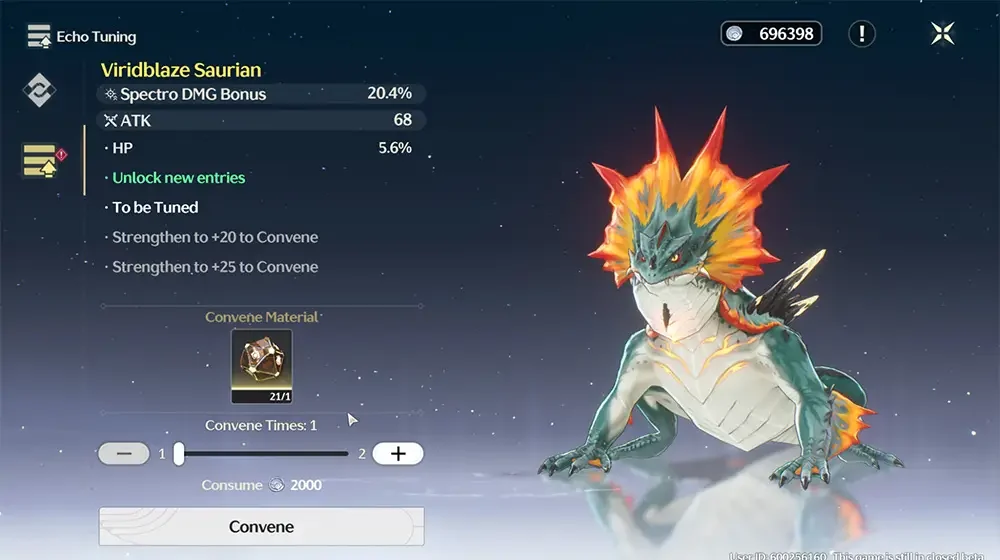
Echo sets, called Sonata effects in Wuthering Waves, activate when enough equipped Echoes belong to the same set. Current effects use different piece counts: older sets commonly use two-piece and five-piece thresholds, while later releases also introduced three-piece and one-piece effects. Read the live Sonata Gallery instead of forcing a newer set into an old template.
The practical order is set function first, main stats second, substats third. A perfect-looking CRIT roll on the wrong set is rarely worth breaking the intended effect. A correct-set, correct-main-stat piece with average substats can carry a build while you wait for a genuine replacement.
Where should you farm Echoes?
There is no single best Echo farm because the three common sources solve different bottlenecks. Open-world Tacet Discords can drop Echoes without Waveplates and are useful when you need a specific type or Main Echo skill. Tacet Field Cleanup spends Waveplates but returns set-related Echoes plus Echo EXP and Tuners. Data Merge converts excess unlevelled Echoes into new rolls and is primarily an inventory and reroll tool.
The Data Bank breakpoints that change your farming plan
Data Bank progress matters because it changes what an absorbed Echo can become. You do not need to memorize every level; these four breakpoints explain when a new account should collect broadly and when targeted farming becomes efficient.
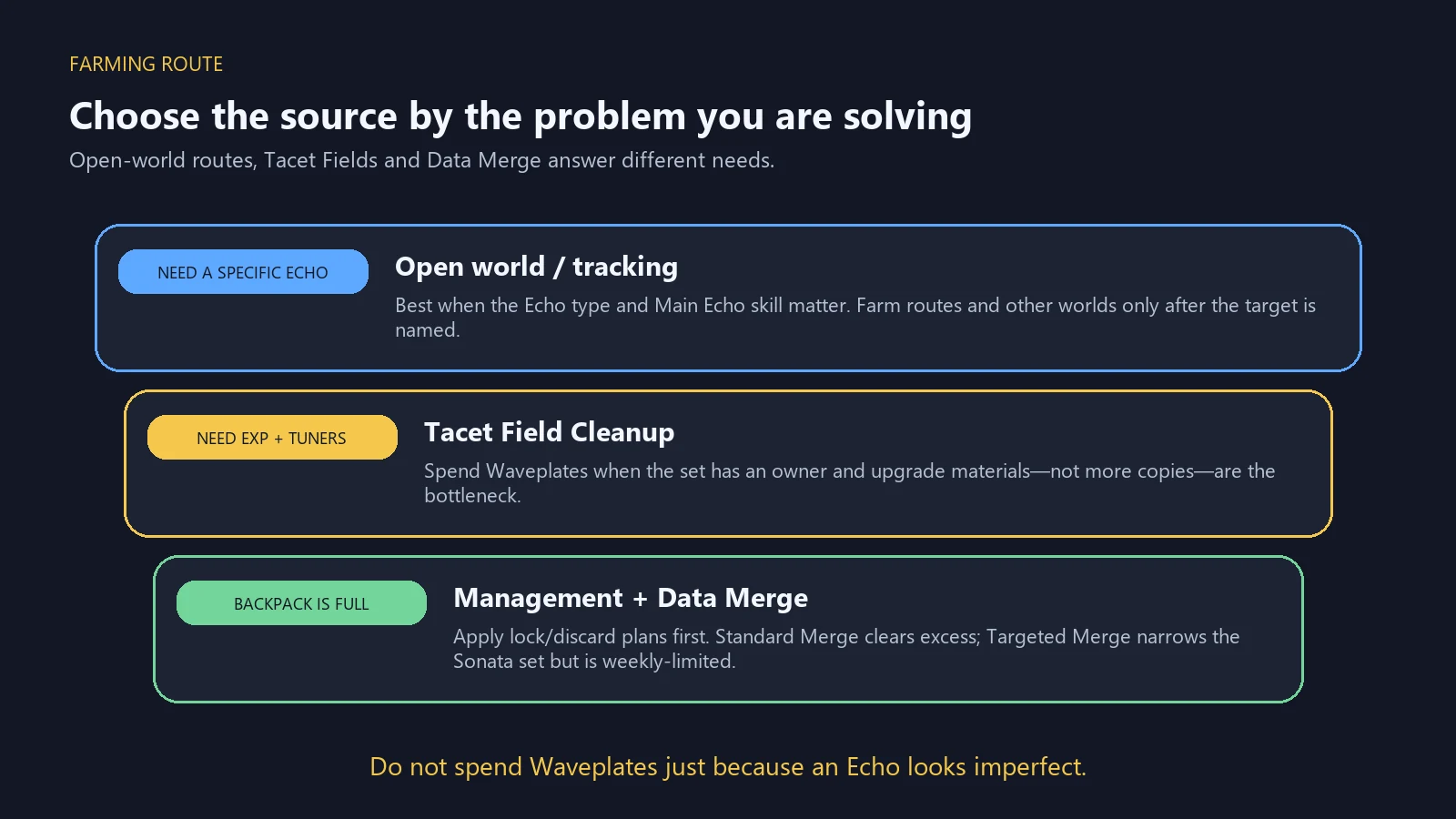
A stage-based farming plan
If your account is still splitting resources across too many characters, return to the Wuthering Waves beginner guide and finish one team before turning Echo farming into a daily project.
When should you stop upgrading an Echo?
A five-star Echo can reach level 25 and reveal up to five substats, one every five levels through tuning. The expensive mistake is treating +25 as the point where you finally learn whether a piece is useful. Instead, compare it at +5, +10 and +15. Each checkpoint should answer whether the Echo still has a realistic path to beating the current slot.
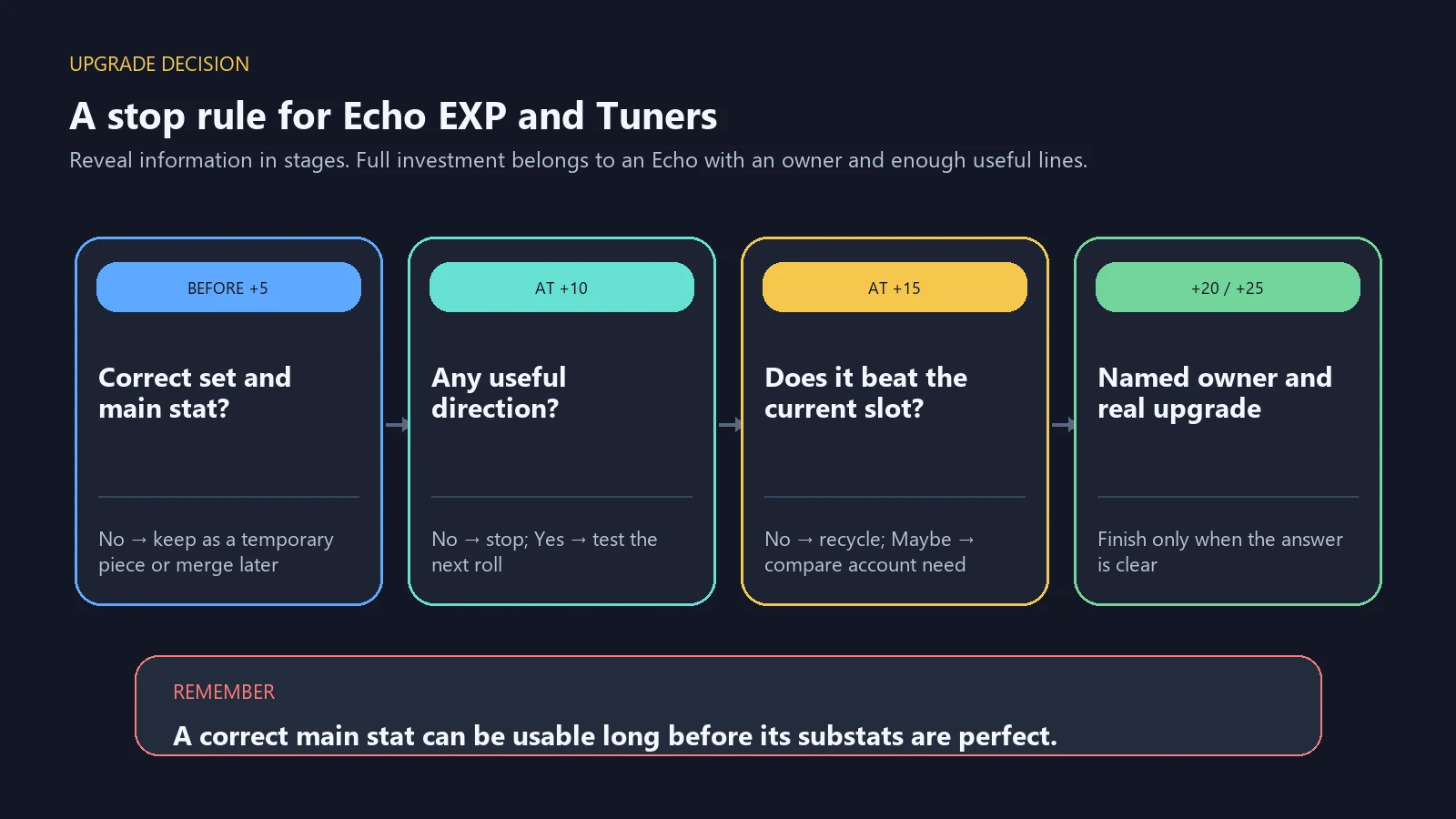
Do not use “no CRIT at +10” as a universal deletion rule. A healer may care more about Energy Regen and HP; a support may need rotation stats; a new account may simply need the correct set and main stat. Judge the Echo against its intended owner and current replacement, not against a generic endgame screenshot.
Why the +10 and +15 checkpoints save resources
Recycling a failed Echo does not return the full investment. Current in-game resource testing and consistently reported live-guide values return about 75% of the invested Echo EXP and 30% of the Tuners. The EXP loss is manageable; repeated Tuner loss is the more punishing long-term leak. Every unnecessary tuned checkpoint therefore makes the next candidate more expensive.
A failed test is not a total loss, but repeated over-investment still consumes roughly one quarter of the EXP each time.
Tuner recovery is much lower, so revealing two or three unnecessary lines across many candidates becomes the real resource drain.
Recycling into EXP materials gives tighter control than feeding a large upgraded Echo directly and accidentally passing the next +5 or +10 review point.
Two examples of the same rule producing different answers
The Sonata effect and elemental main stat match the owner, so test it to +10. One relevant roll may justify +15 if the current slot is weak; flat defensive rolls with no useful direction justify stopping.
Decision: the replacement threshold—not “double CRIT or trash”—sets the stopping point.
The support needs Energy Regen to finish its rotation. HP, DEF or ATK may also be useful when they match the character's scaling. Missing CRIT is not automatically a failure.
Decision: keep it if it fixes rotation timing, even when a damage-focused grading rule would reject it.
When to use Data Modify or Transducers
Data Modify solves a main-stat problem on an unenhanced five-star Echo by consuming a Modifier. Use it when the Echo type or Sonata set is difficult to replace and the main stat is the only missing requirement. Do not spend it on a piece that you could farm easily or that still lacks a confirmed owner.
Substat Modification is a later, more expensive rescue option for a fully tuned five-star Echo. Transducers reroll the unlocked substats while preserving the ones you lock; locking more lines raises the cost, and rejecting the result does not refund the Transducers. That makes it a finishing tool for a nearly valuable piece, not a shortcut for every failed roll.
How to manage, discard and merge unwanted Echoes
Players often search for “salvaging” Echoes, but Wuthering Waves separates several actions. Marking an Echo for discard is an inventory label used by management and filtering. Data Merge consumes eligible unlevelled Echoes to create a new Echo. An upgraded Echo can instead be used as upgrade material or recycled through the available inventory action, returning only part of the invested value. These actions are not interchangeable.
Protect equipped pieces, rare main-stat combinations and candidates already assigned to a character.
Apply a management plan to obvious non-candidates, then review the filtered group before consuming anything.
Use Standard Merge for bulk cleanup or the weekly-limited Targeted Merge when a specific Sonata set matters.
A safe Echo Management plan before an aggressive one
- Auto-mark non-five-star Echoes only after five-star drops are reliable.
- Lock equipped pieces and rare correct-set main-stat combinations.
- Leave Energy Regen, Healing Bonus and unusual scaling pieces for manual review.
- Use Suggested Plans as a starting filter, not as approval for deletion.
- Create separate rules for each Sonata effect instead of one global damage rule.
- Keep the COST 4/3/1 main stats used by the characters who own that set.
- Mark clearly mismatched main stats for discard and batch review.
- Expand rules only after a new character's scaling and build are confirmed.
Echo Management can build lock and discard plans around Sonata effect, COST and main stat, then apply those plans to Echoes already owned. Suggested Plans are a fast starting point, not a final truth: review support sets, unusual scaling and any future character project before batch actions. Recent versions also stack matching unequipped, unupgraded Echoes that share the same type, Sonata effect and main stat, which reduces visible clutter without changing the decision underneath.
Echoes and pull spending are separate decisions
Buying currency cannot improve Echo drops, substat rolls or Tacet Field results. A new Resonator also creates another Echo project, so settle the team role and upgrade budget before adding a pull target. If the target still fits the roster, use the Astrite guide to count claimable currency and the pull-budget guide to combine it with the account's actual pity and guarantee state.
Wuthering Waves Echo FAQ
What is the best Echo COST layout?
4-3-3-1-1 is the common 12-COST default because it fits five slots and gives two flexible 3-COST main-stat slots. It is not automatically best for every Resonator; the kit, Sonata effect and rotation decide the final layout.
When do Echo substats unlock?
Tuning unlocks one substat at levels 5, 10, 15, 20 and 25. Use those levels as decision checkpoints instead of automatically pushing every candidate to +25.
Can you change an Echo's main stat?
Data Modify can change the first main stat of an unenhanced five-star Echo by consuming a Modifier. Save it for a hard-to-replace Echo whose set or type already matches a named build.
Can you salvage unwanted Echoes?
There is no single salvage action for every Echo. Lock candidates first, mark obvious failures for discard, then use eligible unlevelled pieces in Data Merge. For an upgraded piece, compare using it as upgrade material or recycling it through the available inventory action; only part of the invested value returns.
Should beginners spend Waveplates on Tacet Fields?
Usually only after reliable five-star Echoes are available and the team has a named set to farm. Character ascension, the main weapon and key Forte upgrades are safer early Waveplate targets because their progress is guaranteed.
How much Echo EXP and how many Tuners return?
Current in-game testing consistently reports roughly 75% of invested Echo EXP and 30% of Tuners returned. Because Tuner recovery is much lower, staged +10 and +15 checks protect more resources than repeatedly finishing weak candidates.
Mechanics were checked against the in-game Data Bank and official Wuthering Waves update notes for Data Modify and Transducers, Echo Management improvements, and Echo Stack storage.