

Use the recipe requirement—not one “universal” deck—to choose Process Cards for the Kitchen, Forge, and Alchemy Workshop.
Reviewed September 8, 2026 · Community deck tables checked against the published level 1–10 and level 11–20 workbooks.
The tables below give representative deck setups for Homestead levels 1–20. They are drawn from two maintained community workbooks, not from an official AFK Journey database. The workbooks also warn that simulated results can differ from actual results. Treat every setup as a strong starting point, then check the in-game preview before spending materials.
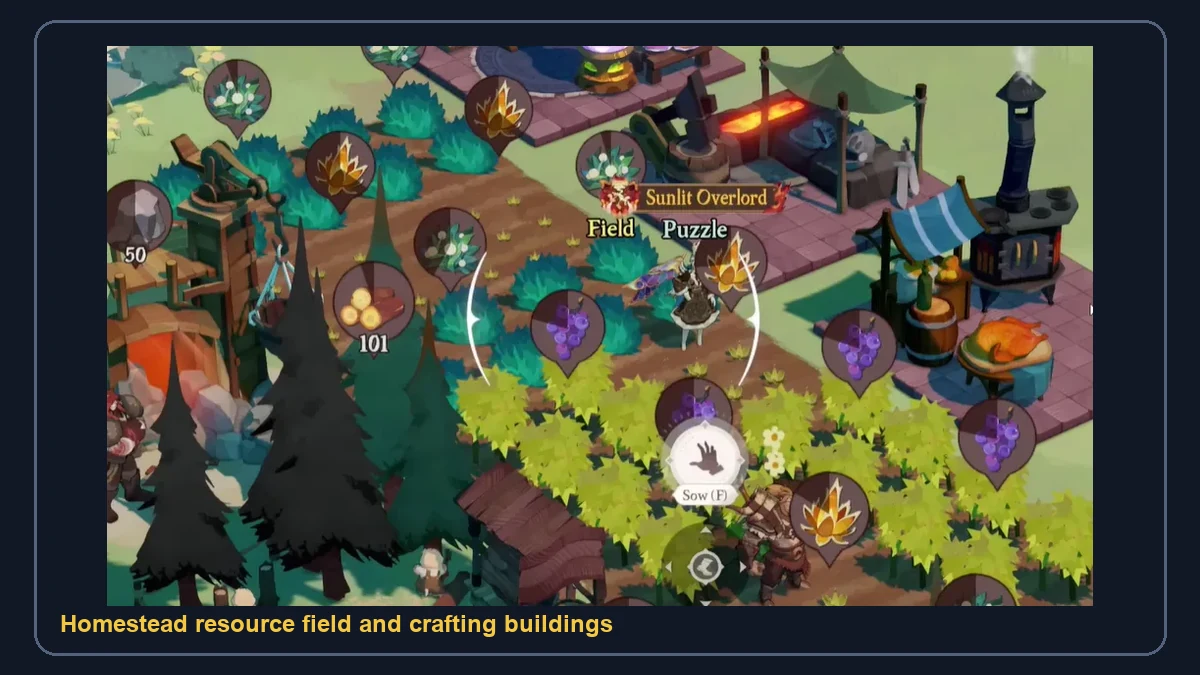
Homestead Recipes, Process Decks, and Cards Explained
Homestead arrived as permanent, non-seasonal content in the 1.4.3 update and unlocks after the quest “Franz the Suspect,” according to the archived patch notes. Later 1.5.1 notes added products and materials and adjusted stamina, material costs, and Process Card upgrade requirements for some levels. That history is why an old deck list can look plausible while still being inefficient today.
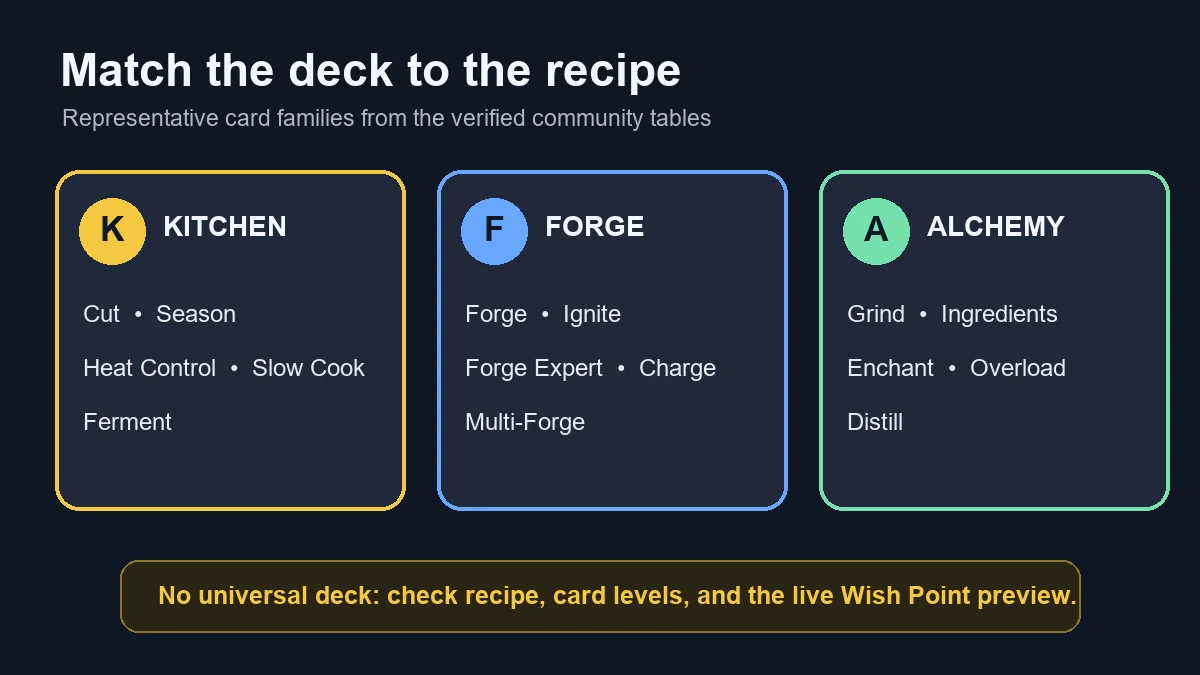
Food products using cards such as Cut, Season, Heat Control, Slow Cook, and Ferment.
Tools and metal products using Forge, Ignite, Forge Expert, Charge, Multi-Forge, and later cards.
Serums, potions, and emblems using Grind, Ingredients, Enchant, Overload, Distill, and advanced cards.
How to Read the Deck Tables
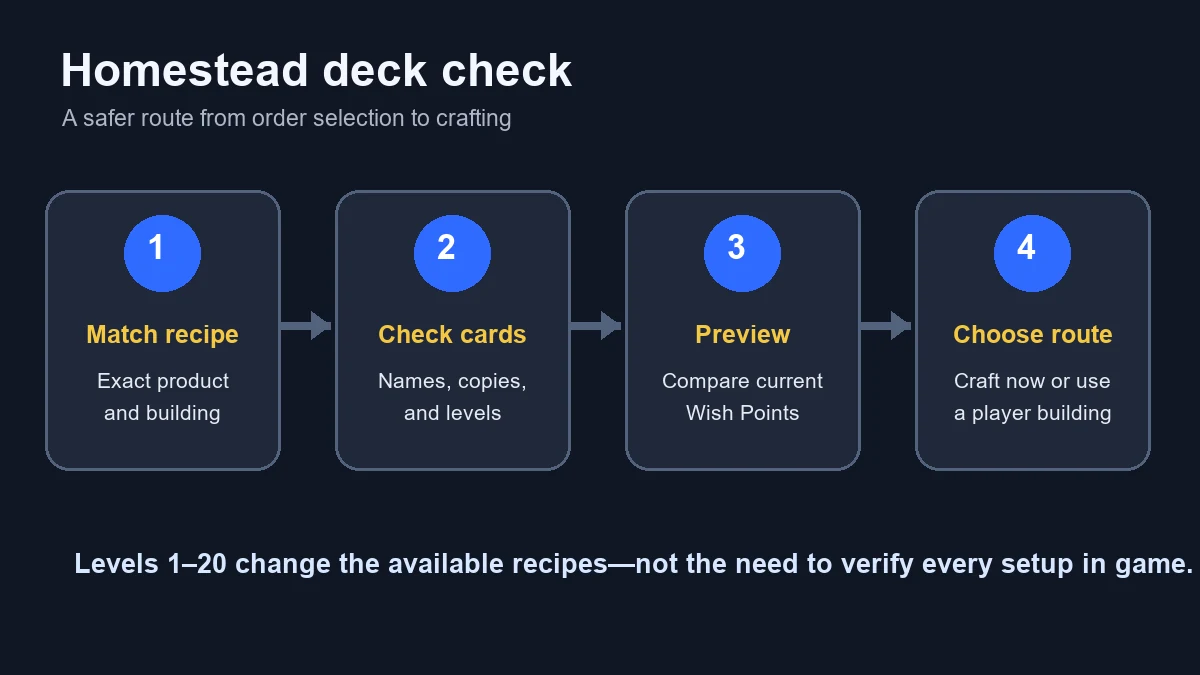
Find the product you need, then confirm three things in the game before crafting: the building level, the recipe requirement, and the level of every card in the suggested deck. Card quantity matters—a line that says “4 × Heat Control” means four copies or uses in the shared setup, not four different Heat Control cards.
The two community workbooks state that a building at level N can receive orders from levels N through N−2. They also describe a fallback for missing card levels: use another player’s building, subject to the workbook’s stated daily product limit. Because these are community-maintained rules, confirm the current limit in your client before relying on it.
Kitchen Deck Examples
Kitchen progression moves from simple Cut and Season combinations into Heat Control, Slow Cook, and Ferment-heavy decks. Upgrade the cards required by your active orders first; upgrading every Kitchen card evenly can leave your most useful recipe short of its target.
| Building level | Recipe | Community deck setup | How to use it |
|---|---|---|---|
| 1 | Round Bread | 2 × Cut 1 × Season | Basic opening recipe; verify both cards meet the recipe requirement. |
| 5 | Grape Vinegar | 4 × Heat Control 2 × Slow Cook | A focused two-card-type deck; useful when those cards are already upgraded. |
| 10 | Odd Sweet | 4 × Heat Control 2 × Slow Cook 1 × Ferment 1 × Season | Check the full eight-card setup before committing materials. |
| 15 | Cool Candied Skewer | 3 × Heat Control 2 × Slow Cook 1 × Ferment | A shorter setup than the level-10 example; recipe needs, not level alone, determine the deck. |
| 20 | Midnight Tea | 4 × Heat Control 2 × Slow Cook 1 × Ferment | Use as a level-20 reference and compare the in-game Wish Point preview. |
Forge Deck Examples
Forge recipes begin with Forge and Ignite, then expand into Forge Expert, Heat Up, Charge, Multi-Forge, Pyroburst, Soulbind, and other advanced actions. Do not assume the newest unlocked card belongs in every deck: the recipe requirement and the score preview are more useful than card rarity alone.
| Building level | Recipe | Community deck setup | How to use it |
|---|---|---|---|
| 1 | Copper Carver | 2 × Forge 1 × Ignite | Simple starter combination for learning how the preview responds to card changes. |
| 5 | Carved Box | 3 × Forge Expert 2 × Forge | The two published workbooks do not show the same older one-copy line, so this review uses the later workbook’s current row. |
| 10 | Firefang Sword | 4 × Forge Expert 1 × Charge 2 × Multi-Forge 1 × Reforge | The level 11–20 workbook contains a second Firefang Sword setup; this is the higher reported simulation row, not a guaranteed result. |
| 15 | Pick Hammer | 2 × Pyroburst 1 × Forge 1 × Heat Up 1 × Charge 1 × Multi-Forge | Mixed deck: confirm every advanced card is available at the required level. |
| 20 | Dust Brush | 2 × Forge Expert 1 × Soulbind 1 × Charge 2 × Multi-Forge | Compare this setup with your card levels; a lower theoretical deck can be better if your key card is underleveled. |
Alchemy Deck Examples
Alchemy should not be removed from a complete Homestead guide. Current community tables contain Alchemy recipes from level 1 through level 20, and player discussions continue to treat the workshop as part of normal Homestead progression. Whether an individual order is worth doing depends on your materials, stamina, card levels, and reward—not on a blanket “always skip Alchemy” rule.
| Building level | Recipe | Community deck setup | How to use it |
|---|---|---|---|
| 1 | Growth Serum | 2 × Grind 1 × Ingredients | Starter Alchemy recipe and the clearest place to learn the building’s card language. |
| 10 | Fireward Ring | 1 × Ingredients 3 × Grind 2 × Enchant 2 × Overload 1 × Distill | A nine-card example; count every slot and confirm card levels before crafting. |
| 11 | Refined Illusion Potion | 2 × Grind 2 × Enchant 2 × Overload 1 × Distill | Shows why a higher building level does not automatically mean a larger deck. |
| 15 | Repellent Sachet | 2 × Enchant 2 × Overload 1 × Distill 1 × Crystallize 1 × Reversal | Advanced mixed deck; missing one required card can make another player’s building the practical route. |
| 20 | Storm Emblem | 2 × Grind 2 × Enchant 1 × Distill 1 × Crystallize 1 × Overcharge | Level-20 reference; check the live preview rather than copying the sheet’s simulated star rate. |
Which Process Cards Should You Upgrade First?
Upgrade cards that repeatedly appear in your current orders. The tables show several recurring foundations: Heat Control and Slow Cook in the Kitchen, Forge Expert and Multi-Forge in the Forge, and Grind plus Enchant in Alchemy. That repetition makes them sensible candidates, but it does not turn them into a universal priority list.
- Open your current order and note the exact product and building.
- Check the recipe requirement and the cards used by a matching deck.
- Upgrade the card that is blocking that recipe—not the card with the most impressive name.
- Recheck the Wish Point preview after each meaningful upgrade.
- If the upgrade cost is too high for one order, compare a friend or guild building before spending.
Materials, Stamina, and Orders: Decide Before You Craft
A workable deck is only one part of a good crafting decision. Before accepting an order, check whether you have the raw materials, whether processing those materials costs stamina, and whether the reward justifies using a limited resource today. The 1.5.1 patch notes specifically mention adjustments to product ingredients and stamina costs, so old “best value” advice should not be carried forward without checking the current client.
Use this order checklist:
- Can your building make the recipe? If not, look for an eligible friend or guild building.
- Do your Process Cards meet the requirement? A copied deck is useless if its key action is underleveled.
- What does the in-game preview show? Compare Wish Points before spending materials.
- Are the materials needed for a better order? Avoid draining a scarce material for a weak reward.
- Did an update change the cost? Recheck after patches instead of trusting an old screenshot.
Homestead Deck Progression from Level 1 to 20
Building level is useful for narrowing the recipe list, but it is not a complete deck guide. Two products at the same level can ask for different actions, and an older recipe may still be the best use of your available materials. Use the level bands below to decide what to check, then return to the exact recipe row.
| Level band | What changes | Best practical move | What not to assume |
|---|---|---|---|
| 1–4 | Small decks introduce each building’s basic actions. | Learn how the Wish Point preview changes when you add or remove one card. Upgrade only the actions required by active recipes. | A starter card is not useless later; Cut, Forge, Grind, and other early actions still appear in mixed decks. |
| 5–9 | Recipes begin asking for more focused combinations and upgraded core actions. | Identify the two or three card types that repeat across your current orders. Those repeated blockers deserve priority. | More card types do not always produce a better deck. Grape Vinegar, for example, uses only Heat Control and Slow Cook in the community row. |
| 10–14 | Decks can become longer and add specialized actions such as Ferment, Multi-Forge, Enchant, Overload, and Distill. | Count every slot, check every card level, and compare the full preview before consuming materials. | A level-11 recipe is not automatically harder than every level-10 recipe; deck size and required actions vary by product. |
| 15–19 | Advanced mixed decks make one missing card more likely to block a copied setup. | Compare the cost of upgrading the missing card with using an eligible friend or guild building. | The highest theoretical star simulation is not always the best daily decision if it consumes scarce materials or stamina. |
| 20 | Late recipes combine established and advanced actions, while community sheets offer multiple score and star targets. | Choose the target your actual cards can support and verify it in the live preview. Save a working deck for the recipe if the game allows it. | A community “best” row is not an official guarantee and may not match a future patch. |
Why a Copied Homestead Deck May Fail
If a listed setup performs worse than expected, the guide is not automatically wrong and your account is not necessarily bugged. Check these differences first:
- Wrong product: similar names do not mean identical processing requirements. Match the recipe name exactly.
- Wrong building level: a deck copied from a higher-level row may depend on a recipe or action you have not unlocked.
- Card level mismatch: owning the named Process Card is not the same as meeting the required upgrade level.
- Missing copies: “2 × Grind” and “1 × Grind” are different setups. Check quantities as well as names.
- Old patch data: ingredient, stamina, and upgrade requirements have changed before. Recheck the game after a Homestead adjustment.
- Simulation variance: the workbook’s average or star-rate estimate describes a model, not a guaranteed individual craft.
When troubleshooting, change one thing at a time. Start with the exact community row, compare the live preview, then replace only the card you cannot support. This makes it clear whether the problem is a missing upgrade, a different recipe condition, or an outdated setup.
AFK Journey Homestead Deck FAQ
Is there one best Homestead deck for every recipe?
No. Recipes use different processing actions and requirements. Build around the selected product, then confirm the result in the game preview.
Are the deck tables official?
No. They come from published community workbooks credited to community contributors and simulators. They are useful references, but the sheets themselves say simulated and actual results can differ.
Why can’t I copy a listed deck?
Your building or one of the required Process Cards may be below the recipe requirement. Check every card in the setup, not just the first card listed.
Should I skip Alchemy orders?
Not automatically. Compare the specific reward, stamina, materials, card requirements, and your current progression. The old article’s blanket recommendation was not supported well enough to keep.
Can I craft in another player’s building?
The community workbooks describe crafting through another player’s building when your Process Card level is insufficient, with a daily product limit. Verify the current limit and eligibility in your client because community rules can become outdated.
Where can I find every level 1–20 recipe?
Use the linked community workbooks for the full Kitchen, Forge, and Alchemy lists. The tables above keep only representative rows so the guide remains readable and does not pretend a simulation sheet is an official database.
ManaBuy’s AFK Journey top-up page lists the products currently sold on the site. Homestead wood, ore, crops, and crafting materials are not sold as direct top-up items.
More AFK Journey Guides
Sources and Verification Notes
- AFK Journey 1.4.3 patch-note mirror — used for the Homestead launch, unlock quest, and non-seasonal status. AFK Global identifies itself as a fan-made site, so this is an archived mirror rather than a developer-controlled page.
- AFK Journey 1.5.1 patch-note mirror — used for later products, materials, and cost/upgrade adjustments, with the same mirror limitation.
- Homestead crafting workbook: levels 1–10 — community deck setups and simulation data.
- Homestead crafting workbook: levels 11–20 — community deck setups and simulation data.
- AFK Journey Wiki: Homestead — secondary terminology and feature cross-check.
- Puzzle Homestead deck walkthrough and follow-up walkthrough — visual community evidence; not treated as official balance data.
- ManaBuy AFK Journey product page — used only to verify what ManaBuy actually sells.